MOT Inspection Checklist & Tips
Every year, nearly 30% of cars in the UK fail their MOT test on the first attempt—often due to simple, easily preventable issues like blown light bulbs or empty windscreen washer fluid.
Preparing your vehicle before taking it to an approved testing station can save you time, hassle, and money. This complete MOT inspection checklist & Tips walks you through what testers inspect, how to perform a 10-minute DIY pre-MOT check at home, and the top tips to pass your test on the first try.
Official MOT Inspection Checklist: What Testers Check
The MOT test is a statutory inspection mandated by the Driver and Vehicle Standards Agency (DVSA) to ensure your vehicle meets minimum safety and environmental standards.
Here is what is inspected during your test:
Lights, Indicators, and Signals
Tyres and Wheels
Driver’s Field of Vision & Glass
Brakes & Suspension
Exhaust & Emissions
Top Tips to Pass Your MOT Test First Time
| Tip | Impact | Why It Helps |
| Warm Up the Engine | High | Drive the car for 15–20 minutes at highway speeds prior to testing to ensure the catalytic converter reaches optimal operating temperature for emissions testing. |
| Book 1 Month Early | High | You can take your test up to 1 month minus 1 day before your current certificate expires while preserving your original renewal anniversary date. |
| Fix Minor Issues First | Medium | Replacing a £2 bulb or £8 wiper blade yourself avoids paying garage labor rates or failing the test over trivial items. |
| Check Dashboard Warning Lights | High | Any illuminated red or amber warning lights (such as ABS, airbag, or check engine lights) will cause an automatic test failure. |
Most Common Reasons for MOT Failure
Lights and signals are the cause of about three out of 10 failures. DVSA data shows that lights and signals, suspension, brakes, tires, and driver’s view blockage are the five most common reasons for failures, making up more than 75% of all failures. The good news is that most of them may be fixed without professional help before your test.
Breakdown of failures by type:
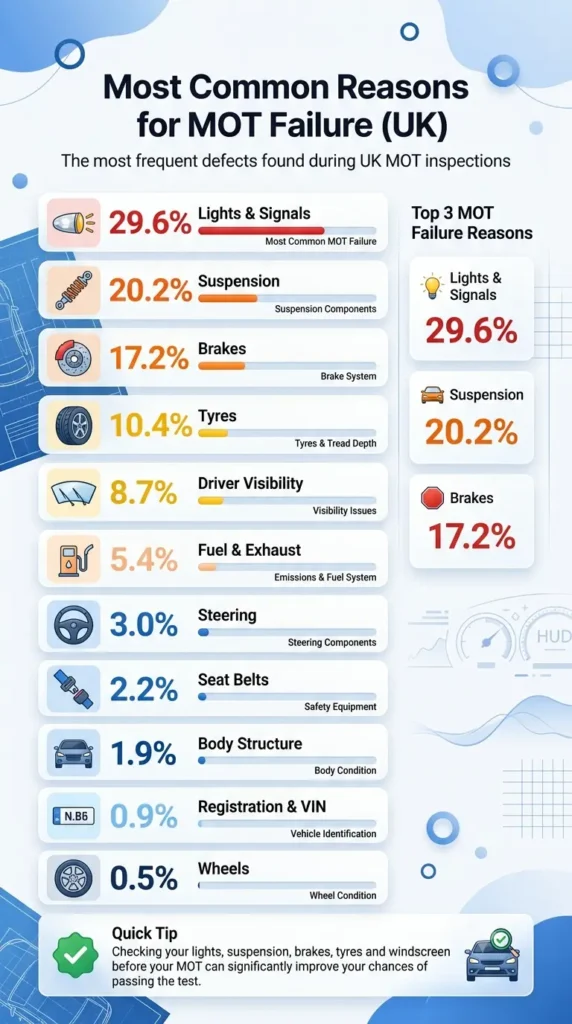
- 29.6% of lights and signals
- 20.2% of people are suspended.
- Brakes: 17.2%
- 10.4% for tires
- 8.7% of the time, the driver sees it.
- 5.4% for fuel and exhaust
- 3% for steering
- 2.2% of people wear seat belts.
- Body: 1.9%
- 0.9% for registration and VIN
- Wheels: 0.5%
Wondering if you need an MOT test or not? See detailed explanation at When a New Car Needs Its First MOT Test (UK)
Checklist Before the MOT
Before going for MOT test, you should follow this checklist so that your MOT test should not be rejected.
1. Lights and Signals (Your Priority)
Check all the lights on your car by walking around it. Turn on the headlights and ask someone to check that both function. Check indicators flash at a sufficient speed. Make sure the brake lights come on when you push the pedal. Check the side lights, fog lights, and lights on the license plate. Check for lens covers that are damaged or foggy. Change a blown bulb right away. This alone stops about 30% of failures.
2. Tires
Use the 20p test: insert a 20p coin into the tread at several points. If you can see the outer band, your tread is less than the legal minimum of 1.6mm, and you will fail. If the tire is unevenly worn, it means that the alignment is off. Inspect for cuts, bulges, or cracks. Ensure matching size tyres are installed on each axle. Check the pressure on all sides of the tire, not just the sidewall, to make sure it is at the right level. Tyres that aren’t inflated enough are a common reason for failure.
3. Windscreen and Wipers
Look for chips under 10mm in the swept area, or 40mm outside. Anything bigger will fail. There are no tears in the rubber blades of the check wipers, and they operate smoothly. Fill up the windshield washer fluid to the top.
4. Mirrors and Seeing
Check that the rear-view and wing mirrors are clean, secure, and not broken. Take down anything that is blocking the windscreen, such sat navs, air fresheners, or dashcam mounting.
5. Brakes and fluids
Add more brake fluid, engine oil, and coolant. Look at the color and level of the steering fluid. Fill the gas tank so the tester can check for emissions.
6. Horn and Seatbelts
To make sure the horn works, give it a brief blast. Make sure that all of the seatbelts are fully extended, correctly retracted, and free of rips or fraying.
7. License Plates
Make sure they are easy to read by cleaning them well. Make sure they are properly fixed and not broken.
8. Keeping things tidy
Remove debris from the boot and inside. If the examiner can’t get to certain places of the car that they need to check, like the seatbelt mountings, they may fail the test.
9. Checks of the engine compartment
Look for leaks that are easy to see. Look for cracks in the hoses. Check that the battery terminals are clean and tight.
You can find the detailed checklist given below in the PDF format. Click the download button to save it on your device for offline access.
Real Life problems Users are Facing
People have strong opinions on how to choose a test center when they talk about it online. Several people on the site say that council-run MOT centers (which only test and don’t fix) are usually fairer than garage-run centers that also handle repairs. It’s easy to see why: repair-only centers don’t make money by failing you. Council centers also usually charge less than regular garages, about £45. But keep in mind that if a dangerous problem is identified, you can’t leave the exam without getting it fixed.
Pre-MOT Inspections
Some garages charge £30 for a pre-MOT check. There are different opinions in the forum. You have to pay extra for this, but it can help you find problems before the test. Instead of hiring garages to check their cars before the MOT, many experienced users now use DVSA videos and guidance to do it themselves.
Concerns about Tester Inconsistency
Subjectivity in MOT testing is a common topic of discussion on forums. People say that different testers look at things like suspension play or brake pad wear in different ways. Some failures seem punitive compared to warnings at other centers that are just suggestions. This has led to talks about appealing failed MOTs through the DVSA. If you lose, you have to pay the entire test charge again, but if you win, you get your money back.
When Your MOT Forum users stress the importance of making sure you book tests correctly. You can get your MOT done up to a month before it expires and still keep your renewal date. If you test earlier than a month, your new certificate will expire one year from the new test date, which means you lose renewal days. Always make your reservations well in advance, especially in the fall when centers are busiest.
Common Problems That Aren’t Talked About
A lot of individuals don’t know that the V5C logbook is only needed for the first MOT or when you change your registration. Bring nothing for standard renewals. Tyre Pressure Monitoring System alerts ensure automatic failure since 2015, so examine dashboard warnings weeks before your test. Some people have been surprised by the results of tests for tainted brake fluid, which are now part of the usual check.
Costs & Fees for MOT
The most a car MOT may cost is £54.85. However, you’ll typically discover bargains at major chains:
The test lasts between 45 minutes and an hour. You can verify the result of your MOT test at our MOT Checker.
What Happens if You Don’t Pass
There are three types of failures: large, small, and dangerous. You can’t drive away if there are dangerous problems, such no brake lights. If you have major issues, you fail but can still drive to get them fixed. Even small mistakes will still get you a pass with advisories. If you fail, you can retake the test for free at the same center within 10 days for some things, such lights, mirrors, tires, wipers, doors, and so on. You have to pay the whole amount again after 10 days or at a different center.
Important Point
Basic light checks can help you avoid about 30% of failures. Problems with the suspension and brakes (37% combined) need more care, but you may see them with a visual inspection. Most people who pass the first time say they did a complete 20-minute home check beforehand, focusing on the lights, tires, and fluid levels. The MOT is mostly about making sure the car is safe and roadworthy, so being honest about how well you take care of it is more important than where you take it or who tests it.
FAQs
Conclusion
Passing your annual MOT test doesn’t have to be nerve-wracking. By following this MOT inspection checklist & Tips, topping up your fluids, inspecting your tyres and bulbs, and warming up your engine before dropping off the car, you eliminate the most frequent failure causes.