
MOT Check – Check Your Vehicle’s MOT Status Online
Every year, millions of UK motorists face the mandatory task of booking their vehicle in for an MOT test.
An MOT (Ministry of Transport) check serves two main purposes: verifying your vehicle’s current roadworthiness
status online and ensuring your car passes its annual physical inspection without unexpected repair bills. Use our all in one MOT checker to confirm a vehicle’s current MOT status, MOT expiry date, tax status, and recent MOT history using a UK registration number.

Vehicles over 3 years old in the UK must undergo an annual MOT test. Driving without a valid MOT certificate can lead to a fine of up to £1,000, invalidate your vehicle insurance policy, and prevent you from renewing your road
tax.
How to Perform a Free Online MOT Check
Checking the current MOT status and historical performance of any UK-registered vehicle is completely free, quick, and accessible online.

What Details Our MOT Check Tool Shows
After you enter your registration number and run a search, your results will usually be organised into three practical areas.
MOT and Tax Status
This section shows:
These two statuses are the first things to confirm if you are planning travel or checking a vehicle before purchase.
Vehicle Details
You may also see:
This helps you verify that the vehicle matches seller claims and paperwork.
MOT History
Your history section can reveal:
For used cars, this is often the most important part of the check.
Why Checking MOT Status Matters
An MOT is the UK’s key roadworthiness check for many vehicles. Vehicles subject to test are divided into classes, and the inspection focuses on safety and environmental standards.
A quick online check helps solve common problems like:
Buying a Used Car? How to Use an MOT History Check
If you’re buying a used car, checking its MOT history is one of the easiest ways to avoid costly surprises. A free MOT history check lets you review previous test results, identify recurring problems, and spot warning signs that may not be mentioned in the seller’s listing.
Repeat advisories
The same advisory (such as rust or worn suspension bushes) appears for several years.
Solution: Expect significant repair costs and inspect the vehicle carefully.
Mileage History
Mileage decreases between MOT tests or shows unusual jumps.
Solution: Avoid the vehicle, as it may indicate odometer tampering.
Frequent MOT Failures
The car fails its MOT almost every year for basic maintenance issues.
Solution: This may indicate poor servicing and neglect by previous owners.
Emissions Problems
Repeated failures for emissions, Lambda sensor, or catalytic converter issues.
Solution: Be prepared for potentially expensive exhaust or DPF repairs.
1200+
Vehicles Checked
3+
Industry Year Experience
800+
Test Passed
1124+
Positive Reviews
How to Understand MOT Test Results Clearly?
Passed
A pass means the vehicle met the required standard on the test date. It does not mean the vehicle is free from wear.
Failed
A fail means the vehicle did not meet the required standard. Review the defect category and whether it was later resolved.
Advisories
Advisories are issues that may need monitoring or repair soon. They often predict next-year failures if ignored.
Common Reasons Vehicles Fail MOT
Many failures are avoidable with quick checks at home. Government data has shown lighting and signaling faults as a major share of failures, with tyres and driver visibility also frequent problem areas.
Here are the most common categories with practical prep tips:

Lights and signalling
Check:
Tyres
Check:
Brakes
Watch for:
Driver’s view of the road
Check:
Suspension and steering
Listen for:
Seatbelts and warning lights
Ensure:
Fluid leaks
Oil, brake fluid, or power steering leaks can trigger a fail. Even small leaks should be checked before a test.
This brief list is designed for homepage clarity. A dedicated “Common MOT Failures and Fixes” page can go deeper with a full pre-test checklist.
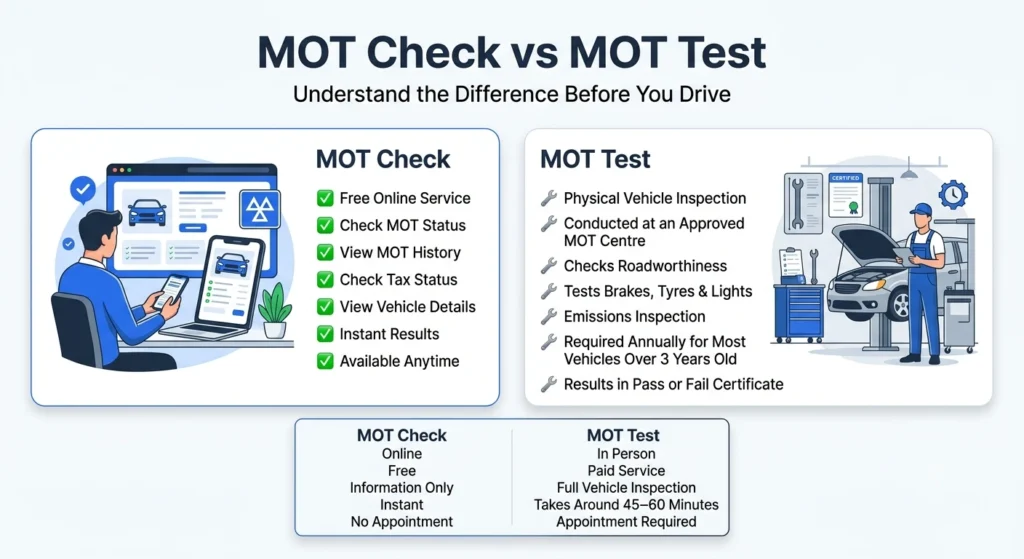
MOT Check vs MOT Test
MOT check is an online lookup that helps you verify current status and review historical test records.
Whereas MOT tests are the physical annual inspection carried out at authorised test centres. The test covers safety and emissions items such as brakes, lights, tyres, steering, suspension, and exhaust-related standards.
The online check helps you prepare. The physical test confirms compliance.
MOT Classes Explained. Helpful Simple Guide
Vehicles subject to MOT testing are grouped into classes. These categories define what kind of vehicle is being tested and which inspection rules apply.
A simplified overview:
Class 1:
Motorcycles and combinations up to 200cc, plus certain small electric variants.
Class 2:
Motorcycles over 200cc and other motorcycles outside Class 1
definitions.
Class 3:
Three-wheeled vehicles up to 450kg unladen weight. Heavier three-wheelers fall into Class 4.
Class 4:
The most common category. It includes most cars, small vans, motor caravans, taxis and ambulances with up to eight passenger seats, plus certain vehicles with 9 to 12 seats under specific rules.
Class 7:
Goods vehicles over 3,000kg up to
and including 3,500kg design
gross weight.
Some public service vehicles fall into Class 6 and 6A and follow specific testing routes. For most everyday drivers, the key takeaway is simple. If you drive a standard car or small van, you are likely in Class 4.
When Should You Run an MOT Check?
You should check your status:
Frequently Asked Questions
Conclusion
We are one of the fastest ways to confirm whether a vehicle is currently legal to drive and to understand how well it has been maintained over time. We help you check MOT status, tax status, vehicle details, and MOT history in seconds.
If you are buying a used car, focus on patterns. Repeated advisories, unusual mileage trends, and frequent fails are stronger signals than a single recent pass. Use our all in one MOT checker to reduce risk and make confident decisions.