MOT Test: Requirements, Checklist & Common Failures
For every driver in the UK, the annual MOT test is an essential legal milestone. Designed to ensure that vehicles on the road meet minimum safety and environmental standards, passing your test keeps you legal, safe, and mobile.
Testing technicians follow strict guidelines set out in the official MOT manual Check, which details every standard, inspection procedure, and defect-evaluation criterion permitted during the check.
What is an MOT Test?
An MOT test (Ministry of Transport inspection) is a mandatory annual assessment for most vehicles over three years old in the UK. Supervised by the Driver and Vehicle Standards Agency (DVSA), the test evaluates whether a vehicle meets statutory road safety and environmental limits.
An MOT test is a legal inspection of safety and emissions—it is not the same as a vehicle service. It does not check internal engine health, clutch wear, or gearbox condition.
Vehicle MOT Classes & Fee Calculator
Not all vehicles are tested under the same set of standards. The DVSA divides vehicles into distinct MOT classes depending on weight, engine size, passenger capacity, and commercial use.
Instant MOT Class Finder
Select your vehicle type below to find its official MOT class and maximum legal DVSA fee cap.
Complete DVSA MOT Class Breakdown
Class 1
Max £29.65
Motorcycles
Motorbikes and engine-driven two-wheelers with engine capacity up to 200cc (with or without sidecar).
Class 2
Max £29.65
Motorcycles (200cc+)
All motorbikes with engine capacities exceeding 200cc (with or without sidecar).
Class 3
Max £37.80
3-Wheeled Vehicles
Three-wheeled vehicles with an unladen weight up to 450kg.
Class 4
Max £54.85
Cars, Taxis & Light Vans
Cars, taxis, motorhomes, ambulances, and light goods vans up to 3,000kg Design Gross Weight (DGW).
Class 5
£59.55 – £80.50
Minibuses & Passenger Buses
Private passenger vehicles, ambulances, and minibuses built with 13 or more passenger seats.
Class 7
Max £58.60
Commercial Goods Vans
Commercial goods vehicles and large vans with Design Gross Weight (DGW) between 3,001kg and 3,500kg.
What Does an MOT Check?
During a typical 45- to 60-minute MOT inspection, a certified tester evaluates your vehicle against official DVSA roadworthiness and environmental safety criteria.
45–60 Min
Average Test Time
6 Key Systems
Inspected Areas
1.6 mm
Min Tyre Tread Limit
10 mm
Max Driver Line Chip
Interactive Inspection System Explorer
Click a category below to filter vehicle systems and view failure probability rates:
Lighting & Signals
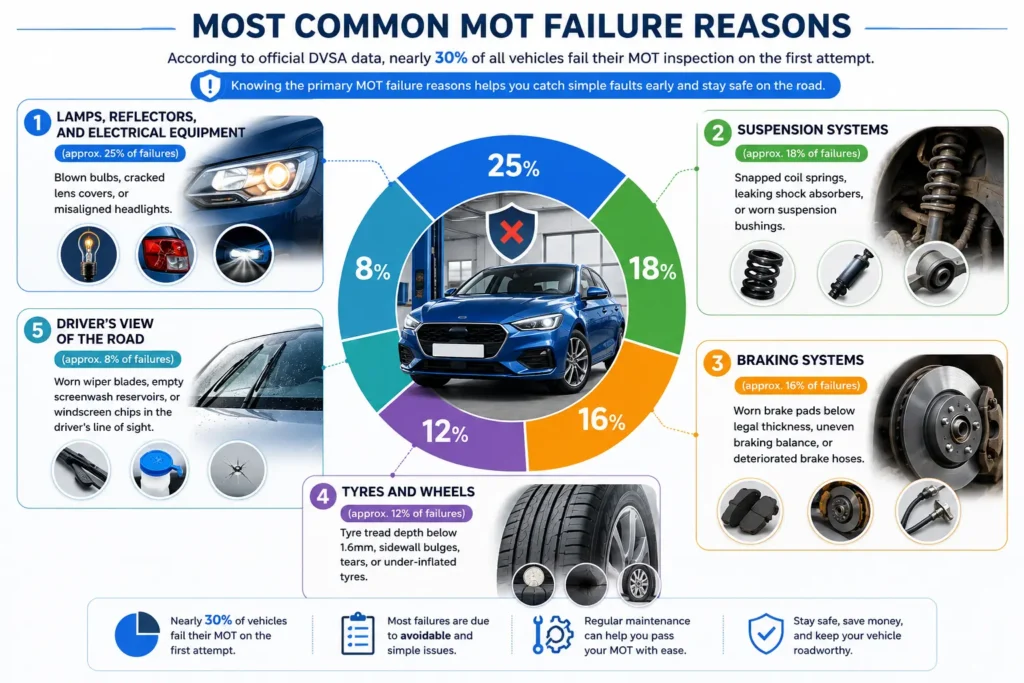
1 Fail Cause (~18%)
Key Check: All light lenses must be free from cracks and discoloration.
Brakes & Tyres
High Failure (~10%)
Legal Limit: Tyre tread must be at least 1.6mm deep.
Steering & Suspension
High Failure (~12%)
Key Check: Suspension springs are a frequent failure point on pot-holed roads.
Vision & Glass
Moderate (~7%)
Legal Limit: Max 10mm chip in Zone A (driver’s view).
Emissions & Exhaust
Moderate (~5%)
Key Check: Visible blue or black smoke will cause an instant fail.
Body & Structure
Moderate (~5%)
Key Check: Corrosion within 30cm of safety components is a fail.
Windscreen Damage Limit Map
The MOT test enforces strict maximum damage dimensions depending on the windscreen zone:
Zone A (Driver’s Direct View)
Centered on the steering wheel, 290mm wide.Max 10mm
Roughly the size of a 10p coin edge.
Remainder of Swept Area
The rest of the area covered by the wiper blades.Max 40mm
Roughly the size of a £2 coin.
MOT Defect Categories & Legal Rules
During an inspection, any identified issues are classified into standard DVSA categories based on safety risk, roadworthiness, and legal driving implications.
Pass
Result: Pass (VT20)
The vehicle meets all required DVSA road safety and environmental standards at the time of testing.
Advisory
Result: Pass (VT20)
Minor wear or early-stage deterioration is present. The vehicle passes the MOT, but the item should be monitored and fixed during routine maintenance.
Minor
Result: Pass (VT20)
A minor defect is present that does not pose an immediate safety risk. The vehicle passes the test, but repairs should be completed promptly.
Major
Result: Fail (VT30)
A significant defect that affects vehicle safety or the environment. The vehicle fails the test and must be repaired before a valid VT20 certificate is issued.
Dangerous
Result: Severe Fail (VT30)
An immediate, severe risk to life and road safety. The vehicle fails the test instantly.
Strict DVSA Legal Penalty Warning:
It is illegal to drive a vehicle with a dangerous defect under any circumstances, even if your existing MOT certificate has not yet expired. Driving a dangerous vehicle carries fines up to £2,500, 3 penalty points, or a potential driving ban.
DIY Pre-MOT Checklist for Drivers
Save time and avoid unnecessary re-test fees by completing this interactive checklist at home before dropping your car off at the garage.
Light Bulbs
Walk around the vehicle and verify that all lights (headlights, brake lights, indicators, hazards, and registration plate bulbs) work correctly.
Screenwash Fluid
Top up your windscreen washer fluid reservoir completely.
Wiper Blades
Inspect the rubber on your wipers for tears, splits, or smearing.
Tyre Tread
Place a 20p coin into the main grooves of each tyre. If the outer band of the coin remains hidden, your tread is above the legal 1.6mm limit.
Dashboard Warning Lights
Turn on the ignition and ensure no persistent warning lights (such as ABS, airbag, or check engine) stay illuminated.
Seatbelts & Cabin
Click and tug each seatbelt to confirm it locks properly, and remove clutter blocking the driver’s view.
FAQs
Conclusion
The MOT test is an unavoidable part of owning a vehicle in the UK, but preparing for it does not have to be stressful. By understanding vehicle MOT classes, tracking common MOT failure reasons, and running through a basic MOT checklist before your appointment, you can keep your car safe, lower repair costs, and pass your inspection with confidence.