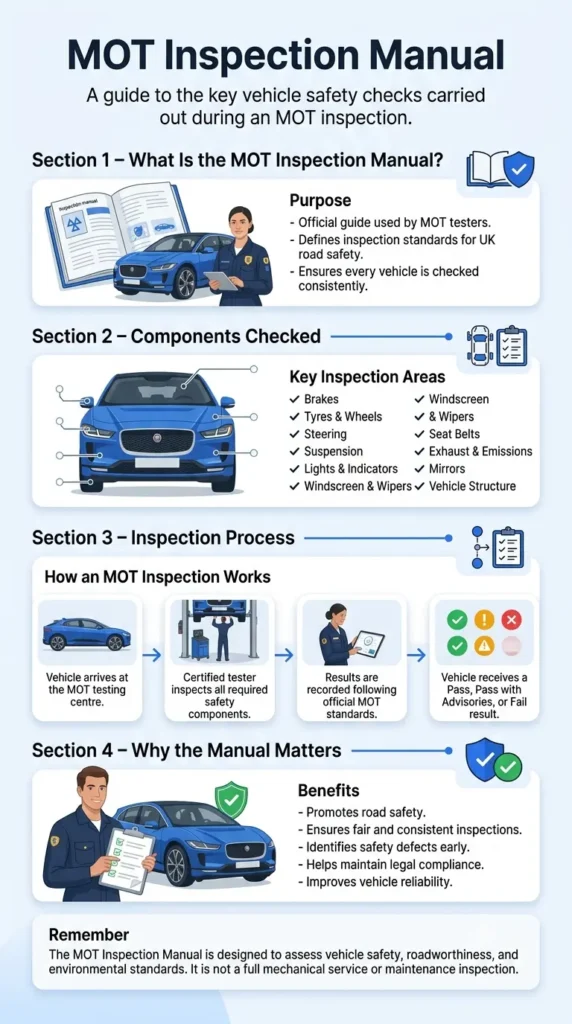
Whether you are a certified MOT technician preparing for your annual assessment or a vehicle owner looking to understand exactly how your car is evaluated, the official DVSA MOT inspection manual is the ultimate authority.
Maintained by the Driver and Vehicle Standards Agency, this comprehensive testing standard outlines every component checked, the testing methods used, and the defect categories applied during an annual inspection. Understanding these guidelines can also help drivers prepare for an MOT checkand avoid unnecessary failures.
The MOT inspection manual is the official statutory testing framework used by approved testing stations across Great Britain. It sets standard procedures for testing Class 3, 4, 5, and 7 vehicles (including passenger cars, light commercial vans, minibuses, and goods vehicles).
While MOT technicians rely on the manual to conduct objective assessments, vehicle owners can use it to view the exact pass and fail criteria used by inspectors.
Key Sections of the MOT Inspection Manual
The DVSA divides the inspection framework into clear numbered sections covering every major vehicle system:
Vehicle Identification
Registration Plates: Condition, legibility, correct spacing, color standards, and secure attachment.
VIN (Vehicle Identification Number): Legibility and presence on chassis or manufacturer plate.
Brakes
Performance & Efficiency: Roller brake testing for minimum stopping efficiency and balance across axles.
Failure rates by category (25% lighting, 19% suspension)
Euro emissions evolution (Euro 6: 0.08g/km NOx)
Component lifespan charts
Cost analysis (£3.7B annual industry spend)
MOT Testers Manual Updates
Critical Changes:
20 May 2025: Refined 3-tier defect system
April 2025: Enhanced brake testing protocols
Headlamp aim: Widened lower tolerance
EV/hybrid considerations added
DVSA Compliance Stats:
10.1% pass vehicles should fail
65.9% have missed defects
Tyres: 734 retest disagreements
Download Your MOT Manual Today
Get instant access to the complete MOT inspection manual with:
16 detailed sections
25+ technical tables
Case studies with repair costs
Preventive maintenance schedules
International standards comparison
FAQs
The complete manual is publicly available online for free on the official GOV.UK portal under the guidance section for private passenger and light commercial vehicles.
The DVSA regularly publishes updates and “Special Notices” to reflect changes in road safety legislation, EV/hybrid testing protocols, and vehicle technology advancements.
Conclusion
The MOT inspection manual is the standard for maintaining safety and environmental compliance across UK roads. By consulting its standards, testers ensure fair evaluations while vehicle owners gain the knowledge needed to maintain their cars and pass their annual tests with ease.
Julia
Julia DVSA-Approved MOT Tester & Garage Owner
Julia has spent the last 12 years in the UK MOT and vehicle inspection trade, working as a DVSA-authorised MOT tester and running her own garages, where she carries out MOT inspections and helps drivers get their vehicles through the test first time.
Her day-to-day work covers the full range of what a UK MOT actually involves — from spotting the tyre, brake, and lighting faults that cause most first-time failures, to talking drivers through what an advisory means versus what will actually fail a car. That hands-on testing experience is what she draws on when writing for My MOT Status: every guide is checked against what DVSA testers are actually required to look for, not just what's written in a general summary of the rules.
Julia writes and reviews My MOT Status's MOT and vehicle-tax content to make sure it reflects real testing standards and stays current with DVSA guidance.