MOT Advisory Check: How to Track, Prioritise, and Resolve Vehicle Warnings
Every year, millions of vehicles across England, Scotland, and Wales undergo their mandatory Driver and Vehicle Standards Agency (DVSA) safety and emissions inspection. Frequently, an MOT certificate comes accompanied by a list of advisory notes.
An MOT advisory check is one of the most effective, underutilised maintenance tools available to UK motorists. Understanding what advisories mean, how to track them online, and how to use them to project future maintenance costs can save you hundreds of pounds in major repairs, preserve your car’s resale value, and keep your vehicle safe on the road.
What Is an MOT Advisory Note?
During an official MOT test, a certified DVSA inspector evaluates hundreds of individual components across your vehicle—including brakes, tyres, steering, suspension, lights, seatbelts, body structure, and exhaust emissions.
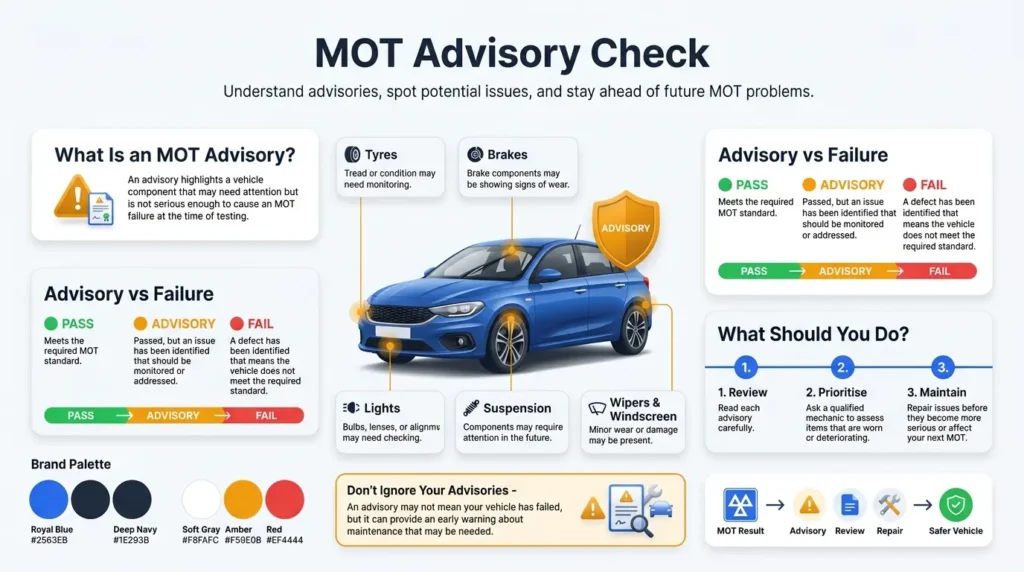
When a tester finds a component that shows clear signs of wear, age, or minor damage, but still meets the minimum legal threshold to pass the test on that day, they issue an Advisory Note.
Advisories act as formal, standardized warnings. They do not invalidate your test or prevent you from receiving a valid MOT certificate. Instead, they serve as an official head-up that a specific part is approaching the end of its operational lifespan and will likely fail in the near future if left unattended.
Why Performing a Regular MOT Advisory Check Is Vital
Many drivers simply fold up their passing MOT certificate, place it in the glovebox, and forget about their vehicle until the next annual inspection. However, regularly running an MOT advisory check provides distinct practical advantages for both current vehicle owners and prospective used-car buyers.
Accurate Maintenance Budgeting
Unexpected car repairs can disrupt any household budget. Advisories act as a financial early-warning system. If your annual test reveals that your front brake discs are “pitted and wearing thin” or your exhaust system has “minor corrosion,” you know in advance that those parts will likely need replacing within the next 3,000 to 6,000 miles. This allows you to spread maintenance costs throughout the year rather than facing a massive bill at your next MOT.
Safer Driving Between Annual Tests
An MOT test is a snapshot of your vehicle’s safety on one specific day. If your car passes its MOT in January with an advisory for a tyre tread depth at 2.0mm, that tyre is legally compliant on test day. However, after driving 4,000 miles through spring and summer, that tread depth will drop below the legal minimum of 1.6mm. Without checking and acting on your advisories, you could spend months unknowingly driving an unroadworthy, illegal vehicle.
Evaluating Second-Hand Vehicles
When purchasing a used car, a clean current MOT pass certificate can be misleading. By using a free online tool like My MOT Status to inspect the vehicle’s full MOT advisory check history over several years, you can uncover critical insights into how the car was maintained:
Breakdown of the Most Common MOT Advisories
DVSA testers rely on a standardized manual of phrases when recording advisories. Here is a breakdown of the most common warnings issued during UK MOT tests, what they actually mean, and the recommended timeframe for action:
| Component Category | Typical DVSA Advisory Text | Real-World Meaning | Recommended Action |
| Tyres & Wheels | Tyre worn close to legal limit (e.g., 2mm) | Tread depth is approaching the legal minimum of 1.6mm. | Replace within 1,000–3,000 miles, depending on driving style. |
| Tyre slightly damaged/cracked/aged | Rubber compound is degrading due to age, UV exposure, or curb scuffs. | Inspect monthly for bulges or worsening sidewall cracks. | |
| Braking System | Brake pads wearing thin | Friction material is reduced (typically under 3mm remaining). | Plan for replacement within 2,000–5,000 miles. |
| Brake disc worn, pitted, or scored | Metal surfaces are uneven or rusting, reducing stopping efficiency. | Replace discs alongside the next set of brake pads. | |
| Suspension | Suspension arm pin or bush worn | Rubber cushioning in control arms is perishing, causing minor play. | Monitor for knocking noises or uneven tyre wear; replace soon. |
| Shock absorber has slight sign of misting/leakage | Hydraulic fluid is starting to seep past seals. | Check suspension bounce; replace shocks in pairs when leakage worsens. | |
| Exhaust & Emissions | Exhaust system has minor leak or corrosion | Surface rust is present or a small join seam is letting out air. | Have a garage inspect the exhaust before a minor hole becomes a loud blow. |
| Vision & Glass | Windscreen damaged but not adversely affecting driver’s view | Small chip or scratch outside Zone A (the driver’s direct sweeping line of sight). | Repair small chips immediately to prevent temperature changes from cracking the glass. |
Conduct a Free MOT Advisory Check Step-by-Step
Checking the current and historical advisories for any UK-registered vehicle is quick, free, and open to the public through DVSA digital records.
How to Prioritise Repairs Based on Advisory Severity
Not all advisories require immediate garage appointments. To manage your vehicle maintenance efficiently, group your advisories into three priority levels:
High Priority (Address Within 1–3 Months)
Medium Priority (Address Within 3–6 Months)
Low Priority (Monitor Annually)
FAQs
Conclusion
An MOT advisory check is a powerful proactive tool for UK drivers and prospective car buyers alike. While advisories do not prevent a car from receiving a valid pass certificate, ignoring them can lead to sudden breakdowns, unsafe driving conditions, and expensive repair bills at your next annual inspection.
By regularly monitoring your vehicle’s advisory notes, prioritizing safety-critical maintenance, and reviewing historical records when buying second-hand, you can keep your vehicle safe, budget effectively for upcoming upkeep, and ensure a stress-free MOT pass year after year.