MOT Classes: UK Vehicle Categories and Test Requirements

Every vehicle driving on public roads in England, Scotland, and Wales must meet strict safety, roadworthiness, and environmental standards. To enforce these standards fairly and accurately across diverse modes of transport, the Driver and Vehicle Standards Agency (DVSA) divides vehicles into distinct MOT classes.

Whether you ride a 125cc moped, drive a standard hatchback, operate a heavy commercial delivery van, or run a community minibus, your vehicle falls into a specific MOT class. Knowing your vehicle’s correct testing category ensures you book the right test at an appropriately authorized garage, avoid unnecessary fees, and stay compliant with UK motoring law.

What Are MOT Classes and Why Do They Matter?

An MOT class defines the specific technical standards, equipment, and inspection criteria applied during a vehicle’s official inspection.

Because a light motorcycle requires completely different mechanical evaluation than a 3.5-tonne commercial transit van or a 16-seat passenger vehicle, test centres must hold specific DVSA authorization, specialized lifts, and calibrated bay equipment tailored to each class.

The DVSA categorises vehicles primarily based on three main MOT Classes attributes:

  • Vehicle Type: Motorcycles, trikes, cars, light commercial vehicles, or buses.
  • Weight: Unladen weight or Design Gross Weight (DGW).
  • Seating Capacity: Number of passenger seats (excluding the driver).

Breakdown of the 8 UK MOT Classes

The UK MOT framework comprises eight official testing classes. Below is a detailed breakdown of each MOT Classes category, covering weight limits, passenger capacities, and typical vehicle examples.
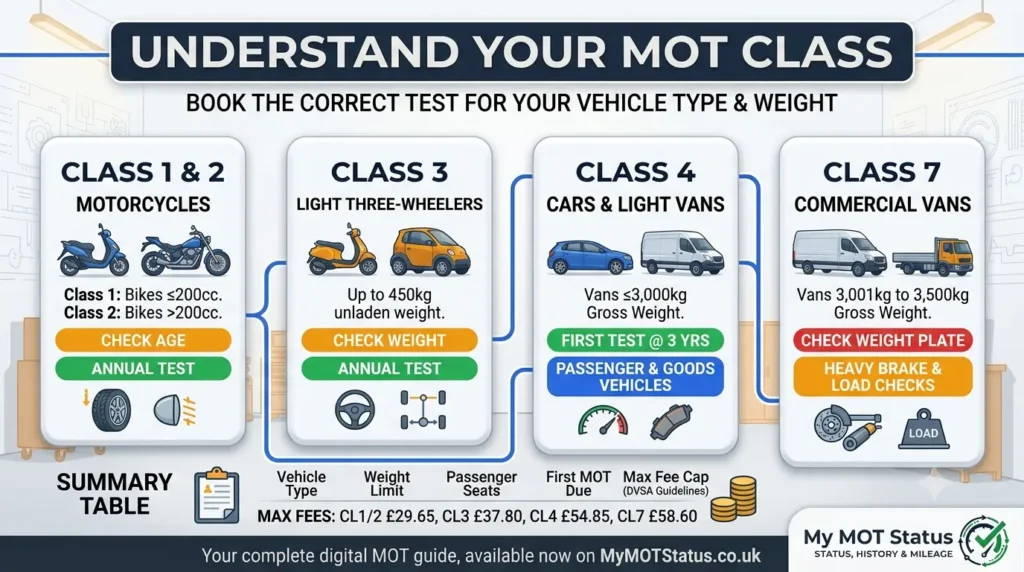
image for mot classes uk

Class 1: Small Motorcycles and Mopeds

  • Engine Capacity: Up to 200cc.
  • Power Output: Includes electrically powered solo motorcycles up to 4kW maximum continuous rated power.
  • Vehicles Covered: Small motorbikes, scooters, mopeds, and motorcycle combinations with engines up to 200cc.
  • First Test: 3 years after initial registration.

Class 2: Standard and Heavy Motorcycles

  • Engine Capacity: Over 200cc.
  • Vehicles Covered: All standard motorcycles, cruisers, touring bikes, off-road road-legal motorcycles, and motorcycle combinations (with sidecars) exceeding 200cc.
  • First Test: 3 years after initial registration.

Class 3: Light Three-Wheeled Vehicles

  • Weight Limit: Up to 450kg unladen weight (excluding motor bicycles with sidecars).
  • Vehicles Covered: Light three-wheeled vehicles, traditional tricycles, and micro-cars.
  • First Test: 3 years after initial registration.

Class 4: Passenger Cars, Light Goods Vehicles, and Small Minibuses

Class 4 is the most common MOT category in the UK. The vast majority of everyday motorists undergo a Class 4 inspection.

  • Vehicles Covered:
  • Standard passenger cars (saloons, hatchbacks, SUVs, estate cars) with up to 8 passenger seats.
  • Goods vehicles and light vans with a Design Gross Weight (DGW) up to 3,000kg.
  • Taxis and private hire vehicles with up to 8 passenger seats.
  • Ambulances and motor caravans.
  • Three-wheeled vehicles weighing over 450kg unladen.
  • Quadricycles (heavy quads).
  • Dual-purpose vehicles (e.g., qualifying double-cab pickups under 3,000kg DGW).
  • First Test: 3 years after initial registration (or 1 year for taxis and certain ambulances).

Class 4a: Passenger Vehicles with 9–12 Seats

  • Vehicles Covered: Class 4 passenger vehicles, small minibuses, and ambulances fitted with 9 to 12 passenger seats.
  • Specific Requirement: Includes mandatory extra checks on seatbelt installation and security for all passenger positions.

Class 5: Large Passenger Vehicles and Private Minibuses

  • Vehicles Covered: Private passenger vehicles, ambulances, and motor caravans with 13 or more passenger seats (including play buses and community transport).
  • First Test: 1 year after initial registration.

Class 5a: Large Passenger Vehicles with Enhanced Seatbelt Checks

  • Vehicles Covered: Class 5 passenger vehicles (13+ passenger seats) requiring specific seatbelt installation checks.

Class 7: Commercial Goods Vehicles (3,001kg to 3,500kg DGW)

  • Weight Limit: Commercial goods vehicles with a Design Gross Weight (DGW) between 3,001kg and 3,500kg.
  • Vehicles Covered: Medium-to-large transit vans, flatbed trucks, large double-cab pickup trucks, and luton delivery vans.
  • First Test: 3 years after initial registration.

Class 4 vs. Class 7: The Commercial Van Threshold

One of the most frequent points of confusion for van owners and fleet managers is determining whether a vehicle requires a Class 4 or Class 7 MOT.

Class 4 Vans

Design Gross Weight: ≤ 3,000 kg

Typical Models: Ford Transit Custom, VW Transporter, Vauxhall Vivaro.

Class 7 Vans

Design Gross Weight: 3,001 kg to 3,500 kg

Typical Models: Mercedes Sprinter LWB, Ford Transit Jumbo, Movano Heavy-Duty.

The crucial distinction lies in the vehicle’s Design Gross Weight (DGW)—also known as Maximum Authorised Mass (MAM) or Gross Vehicle Weight (GVW)—not its actual empty unladen weight:

Where to find your DGW: Look at the vehicle’s VIN/weights plate (typically found on the door frame, under the bonnet, or on your V5C registration document). The highest figure on the plate represents the maximum allowable gross weight.

Maximum Official DVSA Fee Caps

The DVSA sets maximum legally allowable price caps for each MOT class. Authorized test centres may charge less than these figures, but they cannot legally exceed them.

Class 1 & 2

£29.65

Motorcycles

Class 3

£37.80

Light 3-Wheelers

Class 4

£54.85

Cars & Light Vans

Class 4a

£64.00

9–12 Seat Minibuses

Class 5

£59.55+

13+ Seat Minibuses

Class 7

£58.60

Goods 3,001–3,500kg

Vehicles Exempt from MOT Testing

Not every vehicle operating in the UK requires a standard annual MOT test. Common exemptions include:

  • Vehicles Over 40 Years Old: Historic vehicles constructed or first registered over 40 years ago—and not substantially modified—are exempt from annual MOT testing.
  • New Vehicles Under 3 Years Old: Standard passenger cars and light commercial vehicles do not require their first MOT until three years from their initial registration date.
  • Heavy Commercial Vehicles Over 3,500kg: Large goods vehicles (HGVs) and large public buses undergo specialized annual testing at Authorised Testing Facilities (ATFs) rather than standard MOT garages.
  • Tractors and Specialized Agricultural Equipment: Slow-moving agricultural tractors, track-laying vehicles, and works trucks.

How to Find Your Vehicle’s MOT Class Online

If you are unsure which MOT class applies to your vehicle, you can confirm its specifications quickly using digital tools:

  • Check Your V5C Logbook: Refer to section D.2/D.3 for vehicle classification, body type, seating capacity, and revenue weight (DGW).
  • Check Your Vehicle VIN Plate: Locate the weight sticker inside the door shut or engine bay to verify if your van exceeds 3,000kg DGW.
  • Use an Online MOT Checker: Search your vehicle registration plate on My MOT Status to instantly view your official DVSA vehicle profile, historical test records, expiration date, and weight classification.

FAQs

Standard passenger cars, SUVs, and small light vans (with a gross weight up to 3,000 kg) are tested under Class 4. Larger commercial vans with a gross weight between 3,001 kg and 3,500 kg require a Class 7 test. You can confirm your vehicle’s gross weight on its VIN plate (usually found inside the door frame or under the bonnet) or on your V5C logbook.

No. Test centres must have specific DVSA authorization, specialized lifts, and calibrated equipment for each class they inspect. While most local garages are approved for Class 4, fewer facilities have the space and heavy-duty equipment required for Class 7 commercial vans or Class 5 passenger minibuses. Always confirm the garage’s approved classes before booking.

No. Electric and hybrid vehicles are classified using the same criteria as petrol or diesel vehicles—primarily vehicle type, seating capacity, and weight. For example, a standard electric hatchback is tested under Class 4, while an electric delivery van weighing 3,200 kg is tested under Class 7. (Emissions testing is simply omitted for fully electric models).

Conclusion

Understanding MOT classes is essential for maintaining complete road legality, booking the correct test, and ensuring your vehicle undergoes the precise safety evaluations designed for its weight and capacity.

Whether you drive a daily commuter car (Class 4), manage a heavy commercial delivery fleet (Class 7), or ride a motorcycle (Class 1 or 2), booking the right class guarantees an accurate test and keeps UK roads safe for everyone.

Leave a Reply

Your email address will not be published. Required fields are marked *