MOT Preparation Checklist: How to Pass Your MOT Test First Time
Every year, millions of vehicles across the UK fail their Ministry of Transport (MOT) test over simple, preventable issues. From a blown lightbulb to low windshield washer fluid, minor faults account for nearly 30% of all test failures. Fortunately, taking a few minutes for basic MOT preparation before your appointment can help you catch these small issues early, avoid costly re-tests, and ensure your vehicle passes on the first try.
Avoid Preventable Fails: Nearly one in three vehicles fail their annual inspection due to minor, low-cost issues like faulty wiper blades or low fluid levels that can be spotted and fixed at home in under 10 minutes.
What Is an MOT Test and Why Is It Important?
An MOT is an annual safety inspection required by law in the UK for most vehicles over three years old. Conducted by approved MOT testing centers, the exam evaluates whether your vehicle meets strict environmental and road safety standards set by the Driver and Vehicle Standards Agency (DVSA).
Official DVSA Scope Note
An MOT test checks key safety and environmental components, but it is not a replacement for regular engine servicing. Internal mechanical parts like the engine clutch, gearbox, and spare tires are not examined under standard MOT Check guidelines.
Pre MOT Preparation Checklist
By taking 15 to 20 minutes to inspect your vehicle before your appointment, you significantly increase your chances of securing a first-time pass and avoiding unnecessary re-test fees.
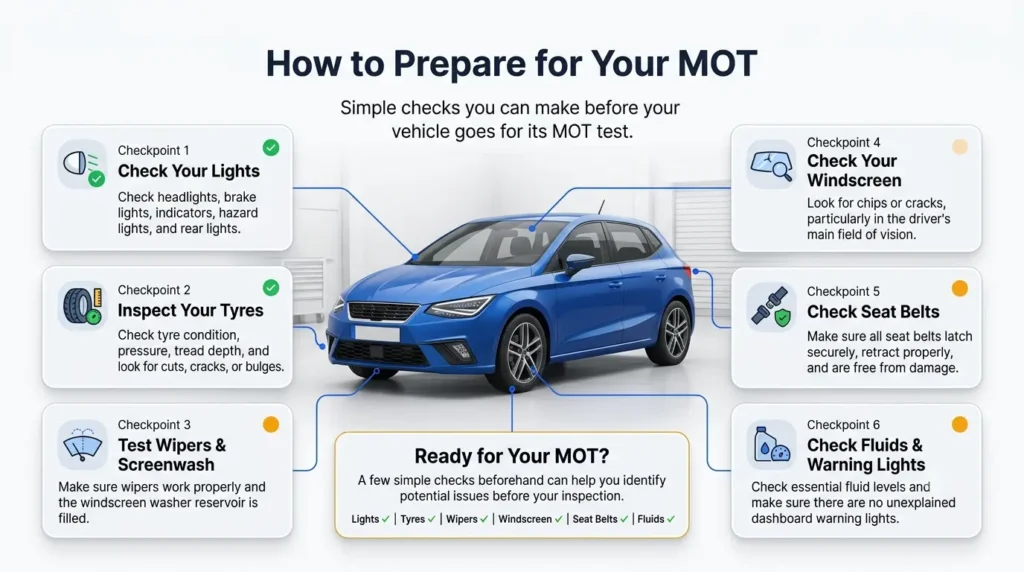
Lights and Indicators
Faulty lights are the number one cause of MOT failures in the UK. Test every exterior light on your vehicle before booking:
Windscreen, Mirrors, and Wipers
Visibility is critical for road safety. Examiners inspect the windscreen for cracks, chips, and obstructions within the driver’s line of sight.
Inspection Area | MOT Pass Criteria | Common Reason for Failure |
|---|---|---|
Driver’s Direct View (Zone A) | Damage must not exceed 10mm. | Cracks or chips directly in front of the steering wheel. |
Rest of Swept Area | Damage must not exceed 40mm. | Cracks outside the direct driver line of sight. |
Windscreen Wipers | Must clear water effectively without smearing. | Split rubber blades or loose wiper arms. |
Washer Fluid | Must spray fluid onto glass when activated. | Empty screenwash reservoir. |
Pro Tip: Clear away any dashboard accessories, mobile phone holders, or hanging air fresheners that sit in the driver’s direct field of vision before dropping off your car.
Tire Condition, Tread Depth, and Pressure
Your tires are the only point of contact between your car and the road. Check all four road tires thoroughly:
Essential Fluid Levels
Running out of essential fluids during an MOT test can prevent the examiner from completing required checks (such as emissions testing).
Seatbelts, Seats, and Interior Controls
Interior safety features are rigorously tested for structural integrity and locking security:
Horn and Steering Action
Bodywork, Exhaust, and Fuel Cap
Registration Plates (Number Plates)
Your license plates must be legible and fully compliant with DVSA legal guidelines:
What Happens If Your Vehicle Fails the MOT?
If your car does not pass its inspection, the testing center will issue a VT30 Refusal of an MOT Test Certificate listing the specific faults categorized as Dangerous or Major.
Minor
Passed
Issued with advisories to monitor or repair soon.
Major
Immediate Failure
Must be repaired to meet safety standards.
Dangerous
Illegal to Drive
Direct threat to road safety. Cannot be driven away.
Partial Re-Test Offer: Most garages offer a free or reduced-cost partial re-test if repairs are carried out within 10 working days at the same facility.
FAQs
Conclusion
Preparing your vehicle for its MOT doesn’t require deep mechanical expertise—just a systematic walkaround and a few minutes of attention to detail. By taking control of basic checks like bulb replacements, tire tread depth, windscreen clearance, and fluid levels, you eliminate the simple issues that account for nearly one in three test failures.
Passing your MOT on the first attempt does more than save you the expense and hassle of re-tests and unexpected repairs; it ensures your vehicle remains safe, reliable, and legally compliant for the road ahead.