MOT Failure: The Most Common Reasons Cars Fail Their MOT Test
Having your car fail its annual Ministry of Transport (MOT) test can be stressful, frustrating, and inconvenient. According to official data from the UK Driver and Vehicle Standards Agency (DVSA), approximately 30% of all vehicles fail their MOT test on the first attempt each year. That equates to millions of drivers leaving testing stations with a failure certificate instead of a fresh 12-month pass.
However, an MOT failure is not the end of the road. Many failures stem from minor, inexpensive issues that take only minutes to fix. Understanding how the DVSA categorizes defects, what your legal driving rights are after a failure, and how to navigate the retest process efficiently will save you time, money, and hassle.
What Happens When a Car Fails Its MOT?
When your vehicle undergoes its inspection at an approved MOT testing station, the certified technician evaluates every component against the official DVSA testing manual. If your car fails to meet the required safety or environmental standards, two main things happen immediately:
The Result is Logged Nationally
The tester records the failure on the central DVSA database. This means police Automatic Number Plate Recognition (ANPR) cameras across the UK are instantly updated with your vehicle’s test status.
You Receive a VT30 Certificate
The garage hands you an official document titled the VT30 Refusal of an MOT Test Certificate. This document outlines every defect found during the inspection and details why your vehicle failed to pass.
VT20 Certificate
PASS
Vehicle meets required safety and environmental standards.
VT30 Certificate
FAIL
Vehicle exhibits Major or Dangerous defects that must be repaired.
DVSA Defect Categorization
In May 2018, the UK government updated MOT testing rules to align with European safety standards, introducing a standardized defect hierarchy. Defects found during an inspection are now classified into four distinct categories. Understanding these classifications can also help drivers estimate potential repair expenses and the overall MOT cost if problems are identified during the test.
Advisory Notes
MOT Result: PASS
An Advisory notice is not a failure point. It indicates that a component is showing signs of wear or slight deterioration (for example, a tyre tread depth measuring 2.0mm, close to the legal 1.6mm limit). While your car passes its MOT with advisories, you should monitor these items closely and schedule repairs in the near future.
Minor Defects
MOT Result: PASS
Minor defects represent small faults that do not pose an immediate danger to road safety or the environment (such as a single license plate light bulb failing when others still function). A vehicle with a Minor defect will still PASS its MOT, but the fault is documented on your VT20 pass certificate, and you are legally required to fix it as soon as possible.
Major Defects
MOT Result: FAIL
A Major defect represents a significant safety hazard, a failure to meet environmental standards, or an issue that puts other road users at risk. Examples include a severely leaking shock absorber, an inoperative brake light, or an exhaust gas emissions reading exceeding statutory limits. Any Major defect results in an immediate MOT failure (VT30 certificate).
Dangerous Defects
MOT Result: FAIL
A Dangerous defect is the most severe classification. It signifies a direct, immediate risk to road safety or severe environmental damage—such as a completely bald tyre with exposed internal cords or broken steering linkages. A Dangerous defect triggers an immediate MOT failure and makes the vehicle illegal to drive under any circumstances.
Top 7 Causes of MOT Failures in the UK
Understanding the primary reasons vehicles fail their annual inspection allows you to address simple problems before taking your car to the test bay. The vast majority of failures involve basic components subject to daily wear and tear.
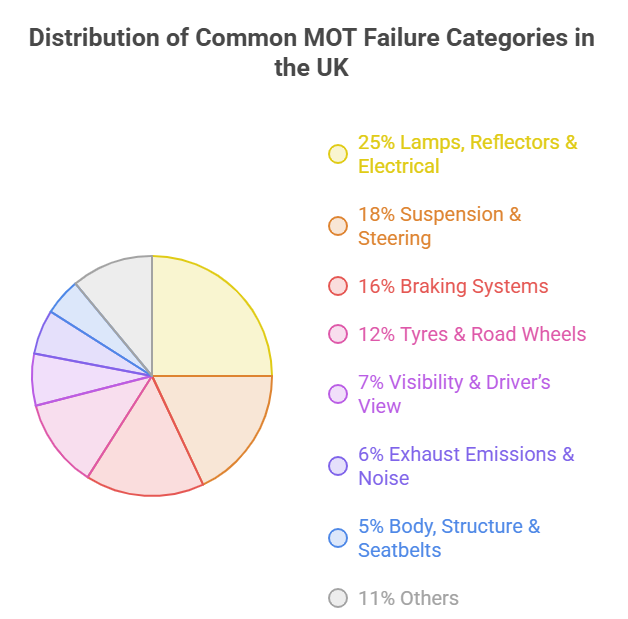
Lamps, Reflectors, and Electrical Systems
Approx. 25% of all failures
Lighting issues remain the single biggest cause of MOT failures in Great Britain. Common failure points include:
Suspension and Steering Systems
Approx. 18% of all failures
UK roads, potholes, and speed bumps place heavy stress on vehicle suspension setups. Common failures include:
Braking Systems
Approx. 16% of all failures
Brake components are vital safety elements checked rigorously on dynamic roller brake testers. Common failure causes include:
Tyres and Wheels
Approx. 12% of all failures
Tyres are your vehicle’s only contact point with the road surface. Testers frequently issue failures for:
Driver’s Field of Vision and Glass
Approx. 7% of all failures
Clear visibility is essential for safe driving. Common vision-related failure reasons include:
Exhaust Emissions and Environmental Controls
Approx. 6% of all failures
Exhaust gases are measured using sensitive gas analyzers to ensure compliance with statutory limits:
Body Structure and General Attachments
Approx. 5% of all failures
Vehicle structural integrity is evaluated on a hydraulic lift:
Can You Drive Your Car After an MOT Failure?
This is one of the most widely misunderstood aspects of UK motoring law. Whether you can legally drive your vehicle away from the test station after a failure depends on two critical factors: the severity of the defect and whether your current MOT certificate is still valid.
Major Defect & Old MOT Still Valid
If you took your car for an MOT test early (for example, two weeks before your existing certificate expired) and it failed with a Major defect, your old certificate remains technically valid on the database until its original expiry date.
Legal Status: You may drive the vehicle, but only for the purpose of taking it to a pre-booked repair appointment or returning it to an MOT test station.
Risk Note: If you drive the car for routine social or commuting purposes and police stop you, you can still be prosecuted under Section 40a of the Road Traffic Act for driving a vehicle in an unroadworthy condition.
Major Defect & Old MOT Expired
If your previous MOT certificate has already expired when the vehicle fails with a Major defect, you cannot legally drive the car on public roads.
Legal Exception: The only legal exception is driving the vehicle directly to a garage for a pre-booked repair appointment or a pre-booked MOT retest. You must be able to prove the booking if stopped by police ANPR units.
Dangerous Defect (Any MOT Status)
If your VT30 failure certificate lists a Dangerous defect, the vehicle cannot be driven on public roads under any circumstances, even if your old MOT certificate has days or weeks remaining before expiry.
Statutory Legal Consequences
Driving a vehicle marked with a Dangerous defect carries severe penalties:
Required Solution: The vehicle must remain parked at the test centre or be transported to a repair garage using a professional recovery flatbed truck.
How to Appeal an MOT Failure Result
If you believe your vehicle was failed incorrectly due to an error, misinterpretation, or unfair assessment by an MOT tester, you have the legal right to appeal the decision through the DVSA.
Do NOT Repair the Vehicle
Do not carry out any repair work or replace any components on the vehicle. Altering the car invalidates your right to an official re-examination.
Obtain Form VT17
Download the official VT17 Appeal Form from the official GOV.UK website.
Submit Within Deadline
You must submit the form to the DVSA within 14 working days of the original test date for mechanical issues, or within 28 days for corrosion/structural issues.
Attend Re-Inspection
The DVSA will schedule an independent re-examination of your vehicle at an official testing site.
Appeal Outcome & Refund
You will be required to pay an initial test fee for the appeal. If the appeal is successful and the DVSA agrees the original tester made an error, your fee will be refunded in full, and a correct VT20 pass certificate will be issued.
Pre-MOT Check to Prevent Failures
Nearly half of all MOT failures can be prevented by spending 10 minutes checking basic components at home before taking your car to the garage:
Conclusion
Failing an MOT test is inconvenient, but knowing the rules keeps you in control. Always review your VT30 certificate carefully to distinguish between Major and Dangerous defects, refrain from driving a vehicle marked with dangerous faults, and schedule necessary repairs within 10 working days to take advantage of free or discounted retests. Running a simple pre-MOT check at home remains the single best strategy to protect your wallet and pass your inspection on the first attempt.