How long does an MOT take?
If you are booking your vehicle in for its annual inspection, timing is everything. Whether you plan to drop your car off before work or sit in the garage waiting room with a coffee, knowing exactly how long does an MOT take helps you structure your day without surprises.
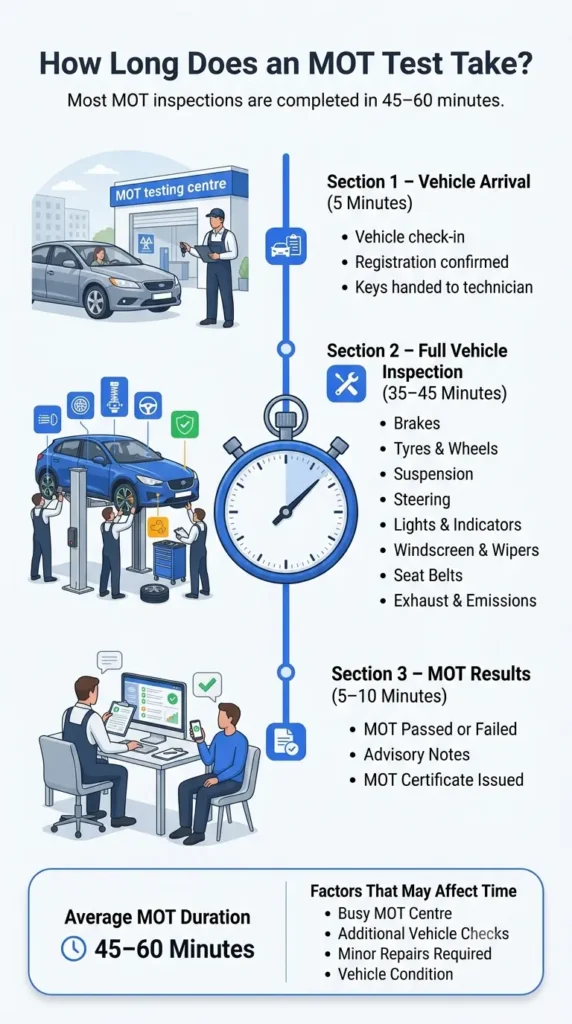
An official UK MOT inspection itself takes between 45 and 60 minutes.
However, you should plan for your car to be at the test centre for 2 to 4 hours (or even a full day). This accounts for garage mot check-in procedures, pre-inspection staging, logging results on the national DVSA database, and potential minor repair work.
Breakdown of the 45–60 Minute MOT Inspection
During the official test, a certified DVSA technician follows strict guidelines set out in the national MOT testing manual. Here is how those 45 to 60 minutes are spent:
Exterior & Cabin Check
(10 Mins)
Testing light bulbs, indicator flash rates, seatbelt locking mechanisms, wiper blade condition, windscreen glass, horn, and door handles.
Under-Bonnet & Steering Inspection
(15 Mins)
Checking power steering fluid lines, battery security, brake fluid reservoirs, and chassis mounting points.
Under-Vehicle & Brake Assessment
(15 Mins)
Elevating the car on a hydraulic lift to examine tyre tread depth, suspension coils, shock absorbers, exhaust security, and running the wheels on a roller brake tester.
Emissions & Exhaust Analysis
(15 Mins)
Measuring tailpipe exhaust emissions against statutory legal limits using gas analyzers.
Database Logging
(5 Mins)
Uploading results directly into the DVSA central system and printing your pass (VT20) or failure (VT30) certificate.
Why Might Your Car Take Longer Than 1 Hour at the Garage?
While the physical test takes under an hour, several real-world garage factors can stretch the overall turnaround time:
| Delay Factor | Added Time | How to Avoid It |
| Garage Backlog & Queueing | +1 to 3 hours | Book a dedicated morning “while-you-wait” appointment slot. |
| Failed Test & Required Repairs | +2 hours to 24+ hours | Run a 10-minute DIY pre-MOT check on lights, screenwash, and tyres at home. |
| Waiting for Replacement Parts | 1 to 3 business days | Book your MOT 2 to 3 weeks before your current certificate expires. |
| Emissions Retesting Delays | +20 to 30 minutes | Take your car for a 15-minute highway drive to warm up the engine before dropping it off. |
Factors affecting MOT time
1) Vehicle type
Different vehicles can take different amounts of time:
2) Repairs and retests (the biggest time factor)
If your vehicle fails, timing depends on what failed and how quickly it can be fixed.
If you have repairs done at the same test centre and return for a retest within 10 working days, you may only need a partial retest, which is typically quicker and can be cheaper than repeating the full test.
3) Garage workload and scheduling style
Even if the MOT itself is fast, the garage may run jobs in batches. That’s why many places suggest:
It reduces your waiting time stress, especially if they discover something that needs a quick fix.
4) Combined services
If you book an MOT at the same time as a full service, plan for 2 to 4 hours or more total. A service adds checks, fluids, filters, and sometimes extra recommendations.
Use your MOT + tax + history check before you book
Doing a quick check first saves time in two ways:
Use your all-in-one tool here:
A useful habit is checking your previous advisories (tyres, brakes, suspension wear) a week or two before the MOT. That gives you time to fix issues calmly, rather than paying “urgent” prices or scrambling for a retest slot.
Simple pre-checks that often prevent delays
These checks won’t replace a proper inspection, but they reduce the common “easy fail” items that waste time:
Pro Tip: If you’re not confident, ask the garage for a quick “pre-MOT check.” It can be cheaper than a fail + retest cycle.
Can You Wait at the Garage During an MOT?
Yes. Approved MOT testing stations provide customer waiting rooms, often equipped with viewing bays or monitors where you can observe the inspector working on your vehicle.
- Pro Tip: If you want to wait, you must explicitly request a “while-you-wait” slot when booking. Garages limit these slots to ensure testers remain strictly on schedule. Expect to spend roughly 60 to 90 minutes total at the garage from check-in to receiving your certificate.
How Long Does an MOT Retest Take?
If your vehicle fails its MOT, the time required for a retest depends on where and when the repairs are carried out:
Same-Day Minor Retest (10–15 Minutes): If the failure is caused by simple items (such as a wiper blade or headlight bulb) and the garage fixes them on the spot, the retest takes only a few minutes and is usually free.
10-Day Partial Retest (20–30 Minutes): If you take the vehicle away for repairs and bring it back to the same testing station within 10 working days, only the failed components are re-inspected.
Full Retest (45–60 Minutes): If you return after 10 working days, DVSA rules require a complete, brand-new MOT test at standard cost.
FAQ
Final thoughts
If you plan around “one hour,” you’re planning for the inspection only. If you plan for real life, give yourself a wider window and do a quick MOT + tax + history check first. Fix the small stuff early, book before your expiry date, and treat advisories as a warning, not background noise. That’s how you keep an MOT from becoming a stressful, multi-day problem.