When a New Car Needs First MOT Test (UK)
A new car in England, Scotland, and Wales usually does not require an MOT until it reaches three years old from the date of first registration. This same three-year rule generally applies to most standard cars, vans, and motorcycles in Great Britain. You can also see your current MOT status.
If you have recently purchased a brand-new vehicle, keeping track of legal roadworthiness milestones can feel confusing. One of the most common questions drivers ask is when a new car needs first MOT test. Understanding the official new car MOT age rules helps ensure your vehicle stays legal on UK roads without booking your first MOT test UK appointment earlier than required.
The key rule that avoids confusion
Your first MOT is based on your vehicle’s first registration date, not:
If your car was first registered on January 1, 2023, your first MOT in Great Britain should be done by January 1, 2026.
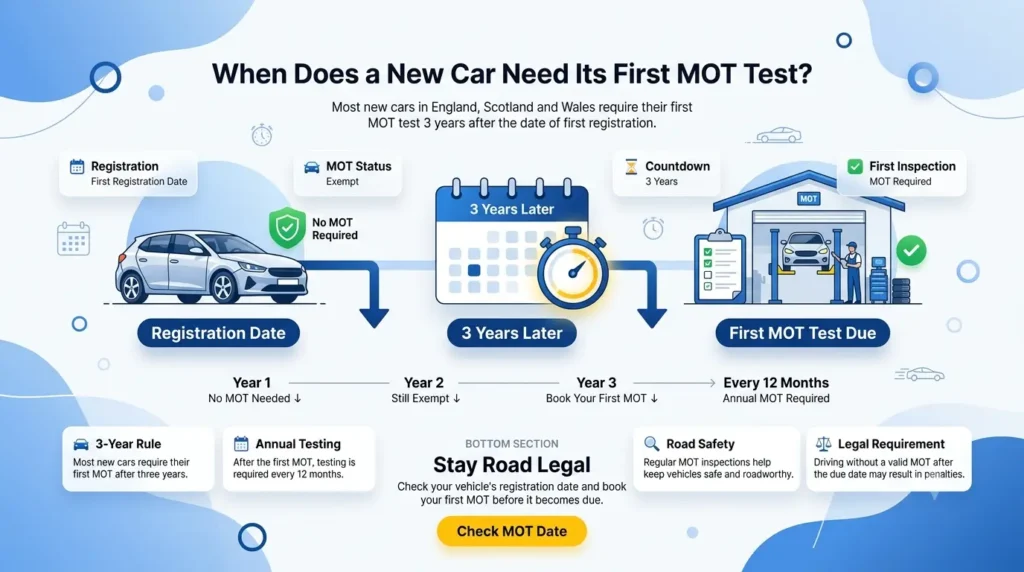
The 3-Year Rule: When is a New Car’s First MOT Due?
In the UK (England, Scotland, and Wales), a standard new passenger car must have its first MOT test three years after the date of its first registration.
During the first three years, the vehicle is legally exempt from annual MOT testing. Once it reaches its third anniversary, it must pass an MOT test every 12 months to remain road-legal.
Example: If your new car was first registered on 15 May 2023, its first MOT test must be completed on or before 15 May 2026.
Exceptions to the 3-Year Rule
While most private cars in the UK follow the standard 3-year MOT rule, some vehicle types and regions have different testing requirements.
Northern Ireland
(4-Year Rule)
In Northern Ireland, private cars do not require their first MOT test until they are 4 years old, calculated from the date of first registration.
Taxis, Ambulances, and Minibuses
(1-Year Rule)
Vehicles used for public transport or commercial passenger services are subject to stricter regulations. The following vehicles must have their first MOT test one year after registration:
Light Goods Vehicles and Vans
Standard light commercial vehicles (LCVs) and vans with a maximum gross weight of up to 3,500 kg follow the same rules as passenger cars. Their first MOT test is due three years after first registration.
How to Find Your Car’s Exact First Registration Date
Your first MOT due date is based on your vehicle’s official first registration date, not the date you collected it from the dealership. To avoid missing your MOT Test deadline, it’s important to check the correct registration date.
You can verify your vehicle’s first registration date using either of these methods:
- Check Your V5C Logbook
Look for Section B – “Date of First Registration” on your V5C registration certificate (logbook). This is the official date used to calculate when your first MOT is due. - Use the GOV.UK Vehicle Enquiry Service
Enter your vehicle registration number on the official GOV.UK Vehicle Enquiry website to view your vehicle’s first registration date, MOT status, and tax information online.
What Happens If You Miss Your First MOT Deadline?
Driving a vehicle on UK roads without a valid MOT certificate after its first MOT becomes due is illegal and can result in serious consequences.
- Fine of Up to £1,000: You can be fined up to £1,000 for driving a vehicle without a valid MOT certificate.
- Insurance May Be Invalid: Driving after your MOT has expired may invalidate your car insurance, which could leave you financially responsible if you’re involved in an accident.
- Automatic Detection: UK Automatic Number Plate Recognition (ANPR) cameras can automatically check your vehicle registration against the DVSA database to identify vehicles without a valid MOT.
Legal Exception: You may legally drive your vehicle only if you are travelling directly to a pre-booked MOT test appointment. Outside of this exception, driving without a valid MOT is against the law.
What happens after your first MOT
Once your car passes its first MOT:
That annual cycle helps detect wear that becomes more likely after the first few years.
Can you get an MOT earlier?
Yes. It’s not mandatory, but you can take a new car for an early MOT if you want extra reassurance.
This can be sensible if:
If you do test early, the certificate is typically valid for 12 months from the test date.
Regional differences
This is the biggest detail many guides miss.
Great Britain
Northern Ireland
If your car has a complex registration or import history, it’s smart to check your due date using a registration-based checker.
Important exceptions
The three-year rule applies to most privately owned standard vehicles, but some vehicles may have different requirements depending on category and usage.
Examples can include:
If your vehicle is used for commercial passenger work or has unusual registration history, confirm your exact requirements.
Booking your MOT
You can book your MOT at an authorised test centre.
To reduce risk of first-time failure, a quick pre-check makes a real difference:
Many early failures are simple fixes.
Consequences of missing your MOT
Once your vehicle reaches the age where an MOT is required, driving without a valid certificate can lead to penalties and may cause insurance issues in real-world scenarios.
There is a narrow practical allowance for driving to a pre-booked MOT appointment, but your car must still be safe and insured.
Future changes
You may have seen discussion about extending the first MOT window. These ideas have been reviewed at different points, but unless the official rules change, the current practical rule for drivers remains:
Quick recap
If you want the answer in one glance: